The SUMO Platform
A single platform integrates all Dynamic Thermal Rating applications in one place
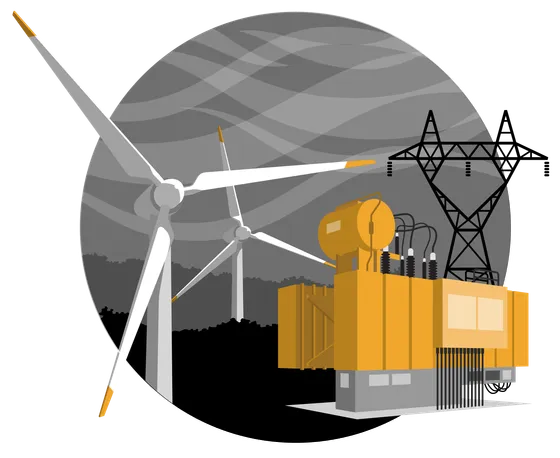
Unlocking Thermal Flexibility in your Power System
Background
Born out of Slovenia's national TSO ELES, SUMO provides Dynamic Thermal Rating of all key elements of the grid, increasing the capacity of domestic power lines, congested international tie lines and power transformers. Running for nine years, SUMO is a deep integral part of the daily operational processes at ELES, including IDCF and DACF.
Find out more about SUMO at ELES in our References section.
At HOPS, the Croatian TSO, they have chosen SUMO to roll out dynamic line rating on over 2500 kilometres of lines across the country.
Architecture & Key Capabilities
The primary input for SUMO's dynamic rating calculation are the ambient conditions along the line, obtained from a combination of a weather service and local weather stations when the terrain demands it. The ampacity of every line span is calculated, and the minimum determines the ampacity of the whole line.
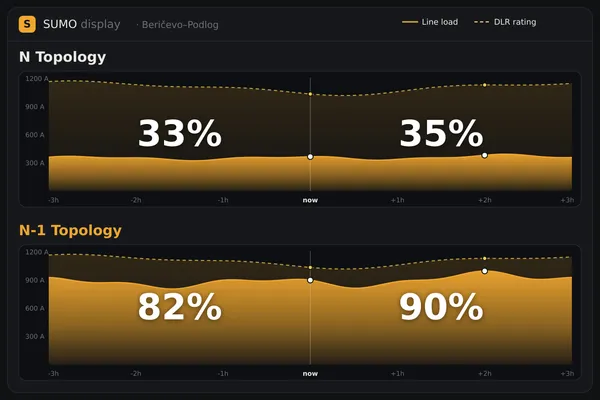
Line currents for N and N-1 provide the line loading percentages, the line temperature along the whole line, and the time it takes to reach maximum allowed temperature. Line sensors allow validation of prediction quality. SUMO is vendor-agnostic, with a rich set of bridging technology to integrate seamlessly with systems such as SCADA/EMS. It is built on a robust enterprise-grade software stack and comes with its own system monitoring.
Deployment Options
SUMO can be deployed on-prem as well as in the cloud. We support active-active and active-standby configurations for high-availability and redundancy, as well as deployments across security zones (e.g. the real-time system in the OT zone and analytics and data archive in the corporate zone). Operato is ISO 9001 and ISO 27001 certified and we monitor all cybersecurity aspects of our platform on an ongoing basis.
Outcomes and Business Value

With Dynamic Line Rating, an operator can increase total line capacity by 20% or more. Precise numbers are line-specific and depend on local terrain, climate and prior static-rating assumptions. As an example, PPL Electric (Pennsylvania) adopted DLR after comparing it to reconductoring and rebuilding: in less than half the time, for far less cost and without line outages, GETs led to a 10%–30% increase in capacity and an estimated $64 million in congestion savings.
More important than the exact number: DLR offers extra flexibility when it is needed, and the possibility to increase revenue from market participation in a safe and controlled manner.
Getting Started

On request, Operato offers an online demo of SUMO, a presentation of use cases, or the potential analysis we do as part of pilot projects. We can also organise a visit to ELES to witness an on-prem, grid-wide SUMO system in action, with the chance to ask questions of experts from the control room and operational planning. Next steps can be a pilot project or a study by Operato experts on the expected benefits of a grid-wide Dynamic Thermal Rating roadmap. See it live.
See SUMO live
Book a live walkthrough of SUMO with the team, or ask about a pilot project and potential-benefit analysis.
See it live